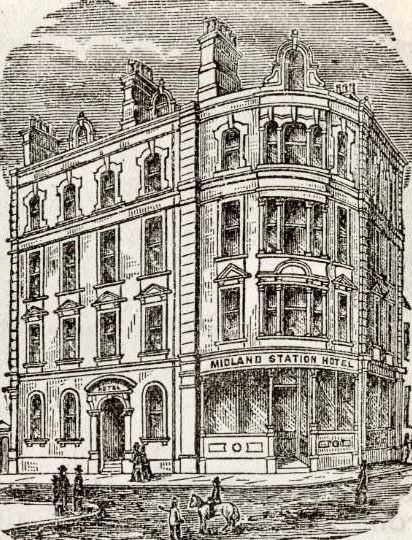
Midland Station Hotel. Image from Industries of Sheffield: Business Review British Industrial Publishing Company, [1888]. Courtesy of Picture Sheffield
A question that was asked of me recently. Why didn’t Sheffield Station have a hotel attached to it? Considering that the Victoria Station had the Victoria Hotel (now the Crowne Plaza Royal Victoria), why didn’t the old Midland Station have one too? Especially when most towns and cities benefited from a large hotel in proximity.
A bit of research suggests that the Midland Station did have a hotel, maybe not the grandest, and didn’t last long.
The Midland Station Hotel was built on Sheaf Street in 1879 and demolished in 1903.
It coincided with improvement works to the Midland Station that gained a handsome new facade, as well as an extra railway line. Sheaf Street was widened and diverted to improve the tramway network to the station.
The land that the Midland Station Hotel stood upon was used to make way for new railway sidings, and these would have been where the present day wasteland (formerly the site of Dyson House) stands today.
The hotel was owned by the Truswell’s Brewery Company, Eyre Street, and opened on Christmas Eve 1879 with George Wood being the first and only tenant, completing almost twenty-four years service, and becoming the oldest proprietor of a commercial and family hotel in Sheffield.
It was bought by the Midland Railway Company in anticipation of the redevelopment and subsequent demolition.
Where in this ever changing city would the Midland Station Hotel have stood?
It’s hard to imagine now, but it is possible to trace its exact location.
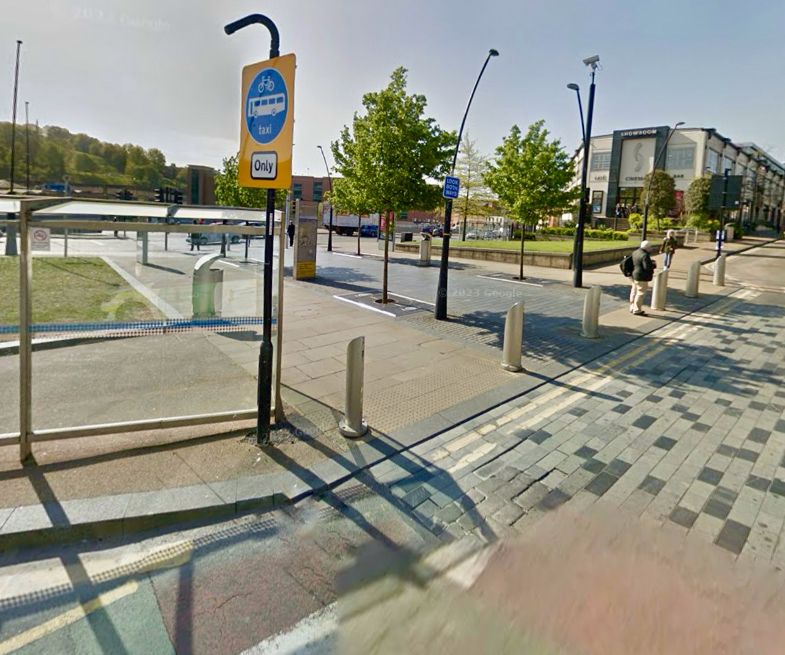
There is a large pelican crossing that crosses Sheaf Street from Sheffield Station to the bottom of Howard Street. It reaches a paved area before pedestrians must cross a narrow stretch of lower Pond Street before proceeding up Howard Street towards the city centre. This paved area is where the Midland Station Hotel once stood.
What I cannot answer is why another large hotel wasn’t built to replace it.
Sheaf Square, once the site of the Midland Station Hotel (1879-1903). Image: Google
It was a rainy Wednesday night, on 14 June 1916, and a soldiers’ buffet was opened at Midland Station for the convenience of soldiers and sailors’ night-travelling through Sheffield. A sailor was the first man in and was on his way to Newcastle to spend brief respite with friends after taking part in the Battle of Jutland.
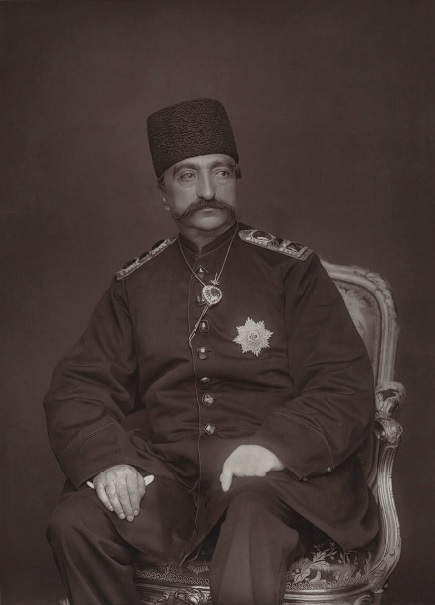
The photograph taken at The Farm, the Duke of Norfolk’s Sheffield residence, by Herbert Rose Barraud. It now belongs to the National Portrait Gallery. (Image: NPG)
Here is a story about a Royal visit to Sheffield that to younger generations will appear extraordinary.
In July 1889, the Shah of Persia (now the Islamic Republic of Iran) was invited to Sheffield by the Duke of Norfolk as part of His Imperial Majesty’s visit to Britain.
The welcome given to Shahanshah, Khaqan, Soltane Saheb Quaran, Quebleye alam (or plain old Naser-al Din Shah Quajar) was on a scale only afforded to British monarchs.
His visit to these shores was politically motivated, with the hope that it might lead to Britain developing Persia’s railways and business interests. Despite the pomp and ceremony that surrounded the Shah the country was regarded a poor relation, but one that might offer riches to our Victorian ancestors.
“Politically, Persia is misgoverned, oppressed, and plundered, and is sunk in barbarism.”
The Shah arrived at the Midland Station on Friday 12th July. He had been fatigued in Birmingham and his journey to Sheffield was delayed, causing unnecessary anxiety to those who had organised the schedule. Nevertheless, the people of Sheffield waited patiently, and gave him a rapturous welcome.
“The sight that met the Shah was one rarely witnessed in Sheffield. Not only were there thousands of people pressing against the barriers, but house tops, walls, boards, and almost every point from which a view of His Imperial Majesty could be obtained was occupied.”
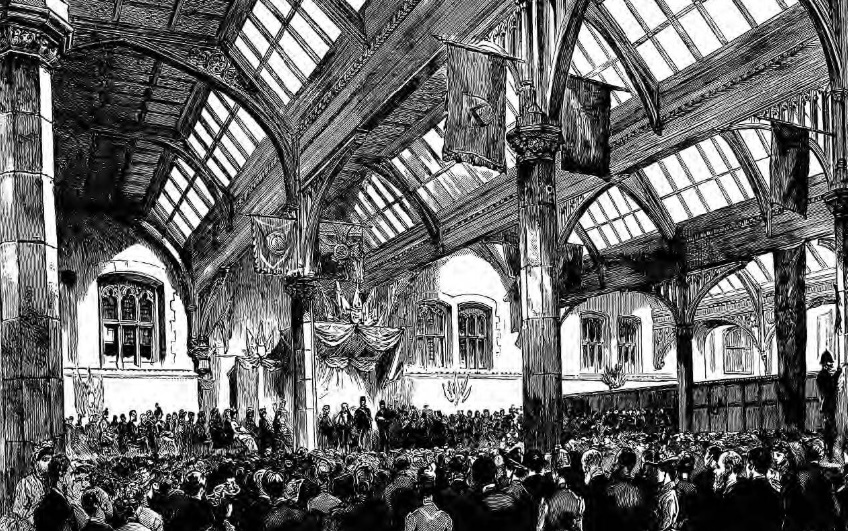
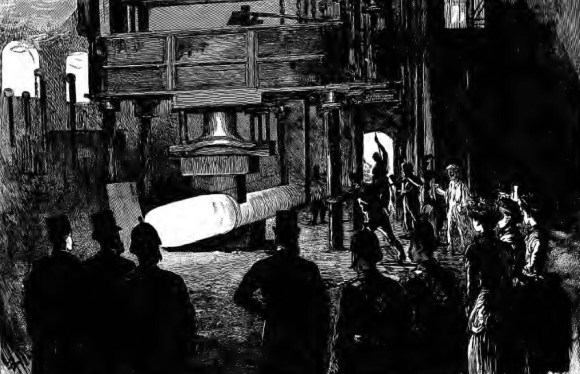
From Midland Station, a huge procession, escorted by a squadron of the Yorkshire Dragoons, made its way to the Corn Exchange where a reception was held. Afterwards he visited the Atlas Works of John Brown and Company before heading to The Farm, the Duke of Norfolk’s residence (now the site of Sheffield College), where he stayed overnight.
The scene in the Corn Exchange during the presentation of an address from the Mayor. (Image: The British Newspaper Archive)
The Shah witnessing the forging of a steel ingot at the Atlas Steel and Iron Works. (Image: The British Newspaper Archive)
Saturday was a rainy day, but it did not stop big crowds gathering along the Shah’s route.
“Flags flapped limply about their poles, the bunting drooped ingloriously, the streamers and floral festoons looked bedraggled, and all the bravery of decoration had departed.”
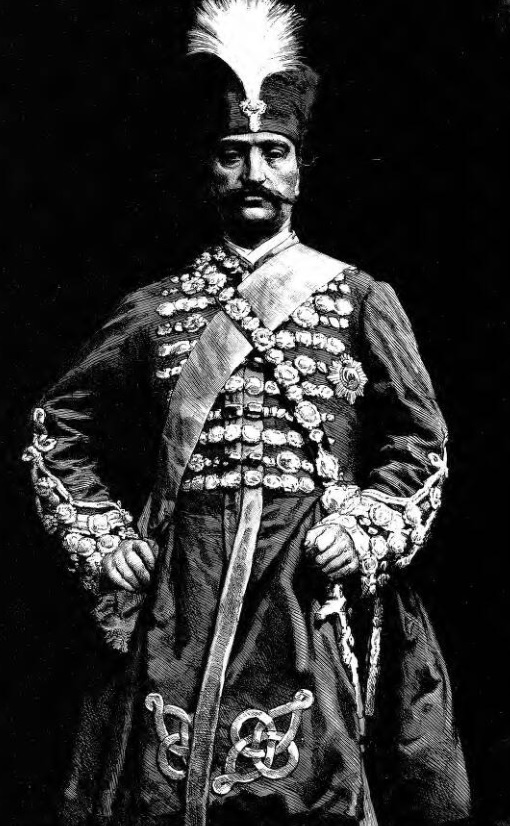
The Shah posed for a photograph at The Farm taken by Herbert Rose Barraud of Oxford Street, London.
“He was dressed in a dark coat fastened with emerald buttons. He wore a shoulder belt across his breast with bars of precious stones including Cabochin emeralds and rubies, the edges bordered with diamonds. Attached to a slender gold chain was the heart-shaped diamond he wore as an amulet; on his breast gleamed a richly jewelled star of the garter. His shoulder straps were studded with emeralds, rubies, and diamonds. He wore a Kolah cap displaying the Lion and Sun of Persia.”
Once again events ran incredibly late, the Shah’s carriages, accompanied by 30 members of the Yorkshire Dragoons, not leaving The Farm until after mid-day.
“Punctuality is the courtesy of Princes, but in Persia it is an unknown quantity. There every man takes his time from the King who, come what may, is never late.”
Despite the long delay, thousands lined the streets as the Royal procession travelled along St Mary’s Road, The Moor and to Norfolk Street where the Shah visited the works of Joseph Rodgers and Sons, including a tour of the vast ivory cellar, before being presented with a handsome sporting knife.
From here, the Shah was transported to the silver plating company, James Dixon and Sons, at Cornish Works, where a whistle-stop tour ended with the presentation of a silver drinking flask.
By his side throughout the visit was a 10-year-old boy favourite of the Shah. It was said that if the opulently decorated boy were beside him no harm could ever befall the Ruler of Persia.
A late lunch was held at the Cutlers’ Hall where toasts were exchanged, with Prince Michael Khan acting as the Shah’s interpreter.
From here he left for Victoria Station which had been gaily decorated, as was the Royal Victoria Hotel, and a guard of honour was formed by the Artillery Volunteers while a band played the Persian National Hymn. His train set off for Liverpool and at Wardsend a battery of six guns was fired to send him on his way.
Sadly, the Shah of Persia was assassinated in 1896 but the monarchy remained until 1979 when it was abolished after the Iranian Revolution.
His Imperial Majesty Naser al-Din, The Shar of Persia. He was assassinated by Mirza Reza Kermani when he was praying in the shrine of Shah-Abdol-Azim in 1896. It was said that the revolver used to kill him was old and rusty and had he worn a thicker overcoat, or been shot from a longer distance, he would have survived. (Image: The British Newspaper Archive)
 sheffielder.net