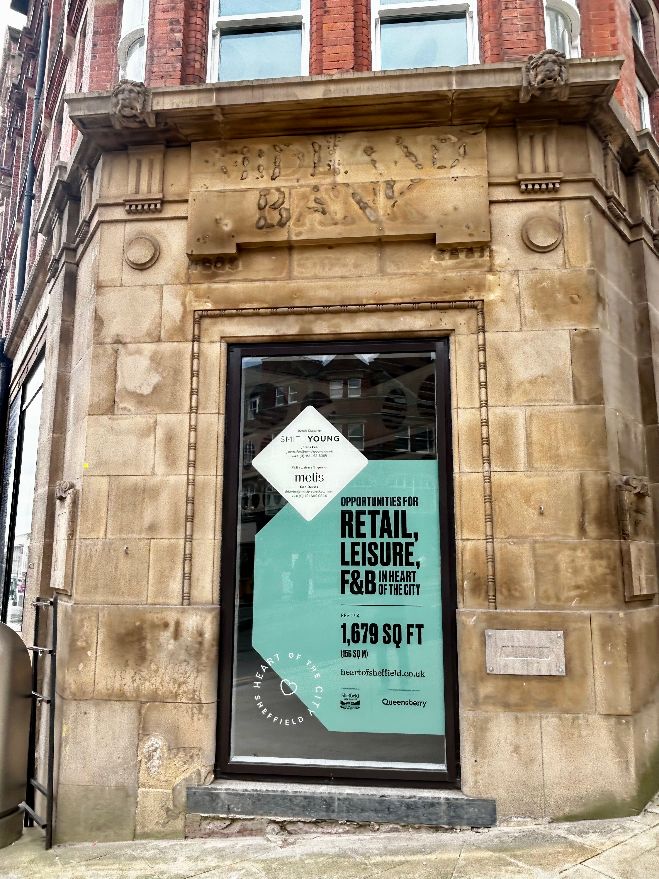
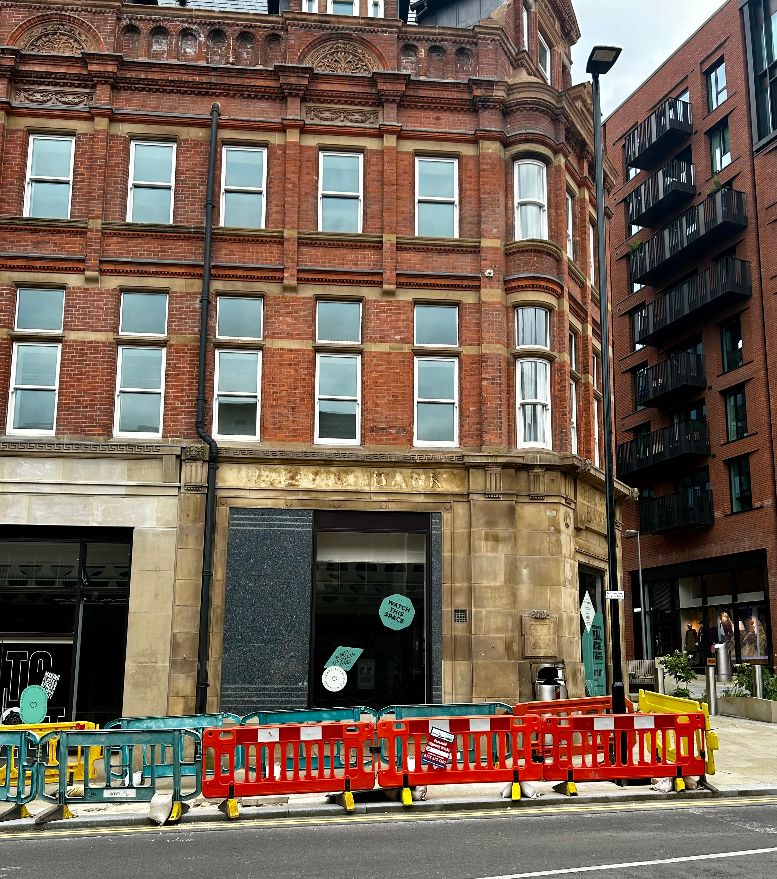
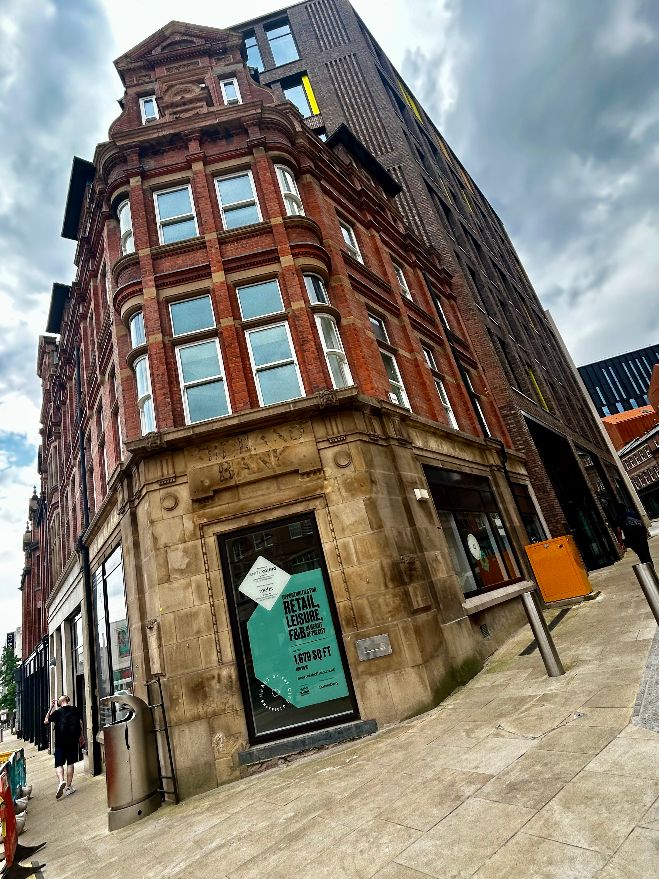
It’s not often that developers leave ghost signs behind, but that is the case with the Isaacs Building at the corner of Pinstone Street and Charles Street. The old Midland Bank signs can be seen, a nod to its past, while much behind the facade is brand new. Midland Bank became part of HSBC in 1992 and this branch closed afterwards.
Pevsner seems to ignore this part of Sheffield city centre, so a bit of detective work was needed to find out about the building’s past. I can trace its construction back to 1888-89 when New Pinstone Street was created. I cannot find the name of the architect, but it was built by William Bissett and Sons, responsible for many important city buildings. Alas, the contract didn’t prove to be very numerative and whilst the company was halfway through work on Carmel House at Fargate, the company failed in dubious circumstances.
Typical of Victorian entrepreneurship, the building was designed as shops at ground level with offices above. The speculative owners of the property were Charles Henry Maleham, a gunsmith of West Bar and Regent Street, London, and Joseph Hardy, stockbroker.
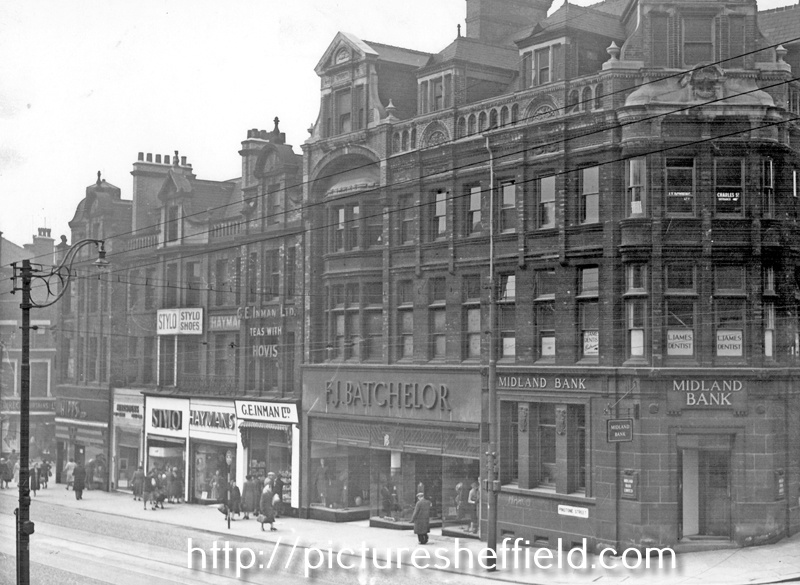
The first shop here was the Public Benefit Furnishing Company that lasted until 1908 when it was taken over by the T & T Tate Furnishing Company which operated until 1925 when Midland Bank moved in and converted it.
I suspect that this was the building that Charles Maleham left to the Town Trustees on his death in 1934. The condition being that income from the property be used to purchase paintings which were to be put on public exhibition. At least twenty-six paintings were purchased including two by J M W Turner and one each by Thomas Gainsborough, Sir Peter Lely and Augustus John.
The building survives as part of the Heart of the City redevelopment and, by coincidence, a nearby building, Grosvenor House on Cambridge Street, part of the same scheme, is now offices for HSBC.
ADDITION – I have added information provided by Robin Hughes who very kindly filled in the blanks.
“The building dates from 1884 – there’s a datestone, and it’s also in the planning register for the time – the same year as the Pepperpot on the downhill side, Pinstone Street having been cut through to Moorhead c1880. This was indeed the building that Maleham left his share of (Nos. 90-92). Although the plans are missing from the archives, the planning register mentions a Mr. Lockwood, who could be the architect H. W. Lockwood, who was also responsible for the spectacular Carmel House (former YMCA) on the corner of Fargate and Norfolk Row.”
© 2024 David Poole. All Rights Reserved.
 sheffielder.net