October 1851
“It’s not that I’m afraid of dying, but I’m more concerned that I might be forgotten.” These words seemed out of character for Thomas Wiley.
William Hollingworth sat in the drawing room at Claremont Place and realised that Wiley was sicker than he had realised, and that his friend was preparing himself for death.
“I’m quite certain that you will not be forgotten,” Hollingworth told him. “Besides, there are a lot of people who owe you a debt of gratitude.”
“I presume that you are referring to my family,” Wiley pondered. “I could not turn my back on them like they once did to me.”
“You never have told me why your father cut you adrift.” Hollingworth hoped that Wiley would finally reveal the cause of the rift.
“That is not important,” said Wiley, “But I vowed that I would make it on my own, and now that I am a rich man, I can provide them with financial support after they bankrupted my father’s drapery shop. I bear them no malice”
Hollingworth liked Alderman Wiley. On many topics he was the main source of information to multitudes; while to a more limited circle his sound and acute judgement made him an invaluable adviser. He did not allow sounding phrases to determine his opinions without the effort to think. He grasped firmly the subjects that came before him, subjected them to analysis, tested their evidence, and rarely failed to arrive at a well-grounded result. And yes, Wiley was a generous man and every Christmas he gladdened the hearts of old people by presents of blankets and seasonal fare. He had no children but had become a ‘father’ to the adopted orphans of several of his relatives.
A few weeks later, Hollingworth remembered that last conversation with Wiley. It was the day of the funeral and he had listened to the story of how Wiley had jumped out of bed, collapsed in a chair, and died at the age of 57. The surgeon had found that Wiley’s heart had been twice the size it should have been. The streets were lined with thousands of mourners as the cortege slowly made its way to St. John’s Church.
October 2024
The story of Thomas Wiley ended that day, but despite his fears, his name lived on for many years afterwards. Yes, he would eventually be forgotten, but by a quirk of fate, his story resurfaces 173 years later.
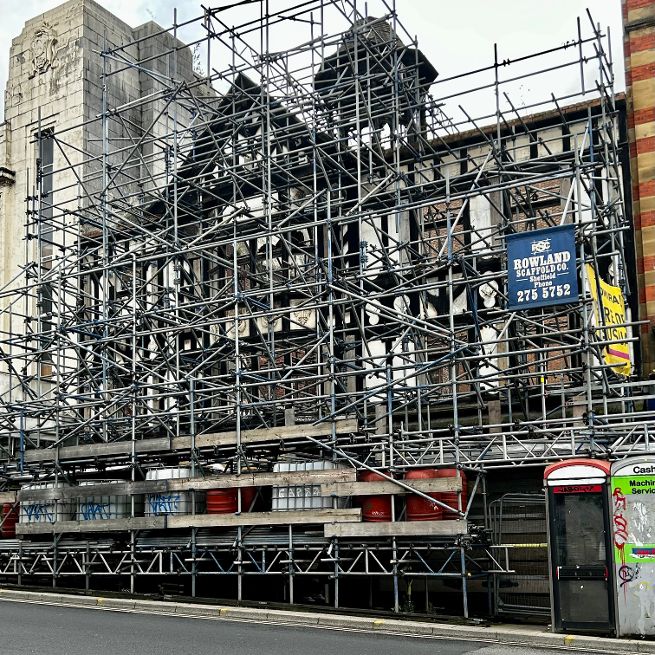
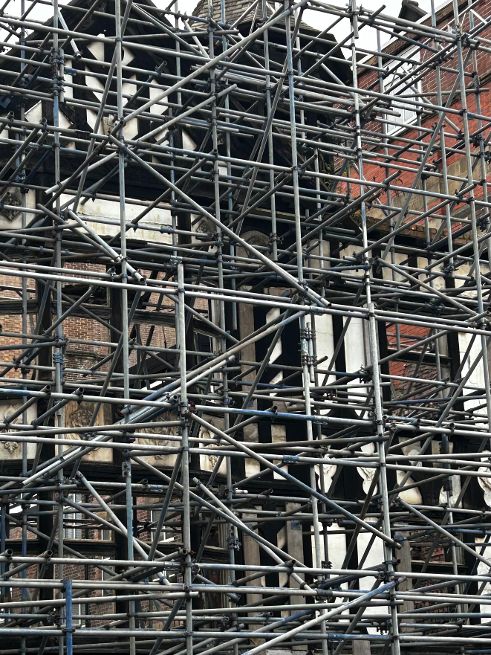
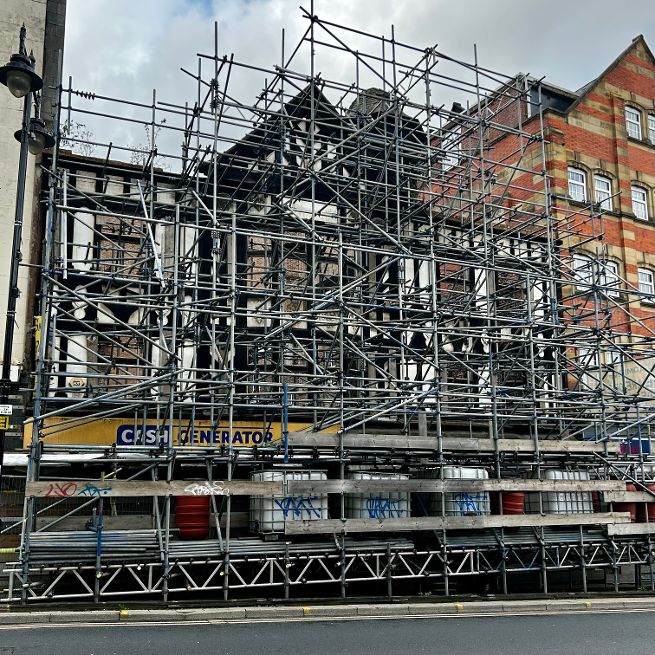
In September, local news reported that Sheffield City Council had stepped in with plans to demolish the frontage of No. 25, Wiley and Co, in Sheffield’s Haymarket. It referred to the century-old Tudor-inspired facade complete with wood and plaster mouldings, a turret, and a dragon perched on top. Five years ago, it gave developer Brijesh Patel permission to demolish the historic building behind and replace it with six storeys of studio apartments, on condition the façade was retained. Alas, the development hasn’t been completed and scaffolding has propped up the flimsy facade until it now poses a danger to the public. According to Hallamshire Historic Buildings, the developer and scaffolder are in dispute, and the latter wants its scaffolding back. Now the council says it must dismantle the building “while at the same time preserving as much of it as possible should the building’s owner wish to reinstate it at a later date, which we hope will be the case.”
Wiley and Co hasn’t been here for a long time, and although the Tudor frontage was believed to have been added in the 1920s, the demolished interior was understood to have dated to the early 19th century.
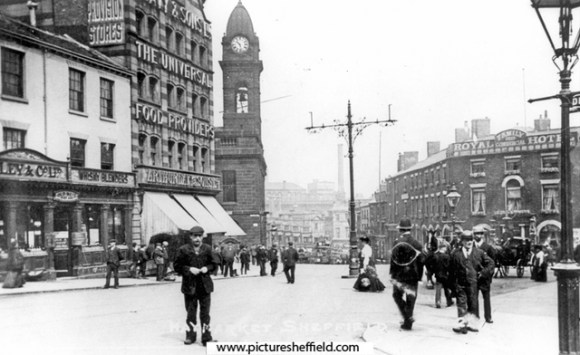
In 1832, Thomas Wiley removed to the Sun Tavern and Chop House at Old Haymarket, opposite the Tontine Inn coaching house. At considerable expense he fitted it up and advertised soups, steaks, chops, snacks served at a few minutes notice, as well as selling excellent old port, sherry, claret, champagnes, amber ale, London draught and bottled porter, prime Havana cigars, and London morning and evening papers.
Wiley added to his business of wine and spirit merchant, that of newsagent, a business in its infancy. At that time, Murdo Young, proprietor of the Sun newspaper, had broken new ground. He had begun to publish late editions of his paper, giving the Parliamentary debates up to post time. The excitement of the public mind throughout 1831 and 1832, caused by the reform agitation, aided his design, and the Sun, far outstripping its older rivals, became the favourite evening paper. On special occasions Young sent his papers by express to the principal towns of England. Wiley became his agent, and frequently brought down the express papers to Sheffield.
Ten years later, Wiley demolished the Sun Tavern and rebuilt it as Old No. 12.
“The design is new and exceedingly appropriate. The fault which has been found with many new shops on account of the disproportionate size and quantity of plate-glass is avoided here. The whole facade is in correct style; the capitals have been expressly modelled from a classic example, and substantially cast in iron. The window frames and doors are of Spanish mahogany, most beautifully executed; and the whole front is surmounted by an elegant balcony, in which the fruit and tendrils of the vine form the principal feature. Altogether, this front may be considered one of the most successful of its kind yet attempted; the architects are Weightman and Hadfield, and the contractors Alcock and Leesly.”
Old No. 12 became a Sheffield institution, not least for the inn, but for the adjacent wines and spirits business called Wiley and Co, and the fact that Wiley had also set up probably the town’s first newsagency.
“We observe with pleasure that Mr Wiley has long since parted with his pigeons, he would not suffer the public to be without authentic information on the Leger race; to effect, which, he sent his man from the course with a horse and gig, which arrived in Sheffield an hour and a half after the race was over, i.e. at five o’clock.” – Sheffield Independent – Sat 16 Sep 1843.
In the 1840s and 1850s, ‘Wiley’s Window’ was famous. In that window all the events of the day were chronicled – debates in Parliament, election results, deaths and disasters, all these occurrences which later formed the stock-in-trade of morning and evening newspapers. When rumours were rife on any subject, it was to Wiley’s window that the people flocked, quite sure that if anything had come through it would be posted up there. Wiley made great efforts to get his news, and it is said that more than once he ran special express coaches to London and back simply to have the first news of something of outstanding importance for his window.
“The great and popular rendezvous for all the superficial and some of the really thoughtful politicians is Mr Wiley’s Window, the well-known Old No. 12, Haymarket. We have much been pleased this week, during the Ministerial changes, as we have often been before, to see the peaceful grouping and pleasing excitement caused by the frequent and varied announcements which have been made in their proper and convenient order. As well as lounging and idle newsmongers, many an industrious tradesman and shopkeeper, and even families and females, in times of excitement, often derive their first knowledge of important commercial and national intelligence, by means of mornings or afternoon messengers despatched to Wiley’s Window.” – Sheffield Independent – Sat 4 July 1846.
He issued every year the ‘Sheffield and Rotherham Historical Pocket Almanac’. This was an invaluable book of reference, with local information for public bodies and institutions connected with the Borough. It was issued free of charge to all friends and customers at Old No.12. From this it seems that Thomas Wiley, in addition to the wine and spirit business, ran the newsagency, obtaining papers by coach, and later by railway, from all over the country and distributing them to subscribers in Sheffield, while local papers, which included the Sheffield Iris, Mercury, and Independent, the Doncaster Gazette, and Leeds Mercury, were on sale on the morning of publication.
Following Wiley’s death, the business was run by his widow for a short time before ending up in the hands of John Roebuck, a member of the Town Council until his death in 1867. George Trickett became the proprietor of Old No. 12 with his sons, Frederick and Francis, succeeding to the business of Wiley and Co. Francis served on the board of Tennant Brothers brewery when it acquired Wiley and Co in 1904.
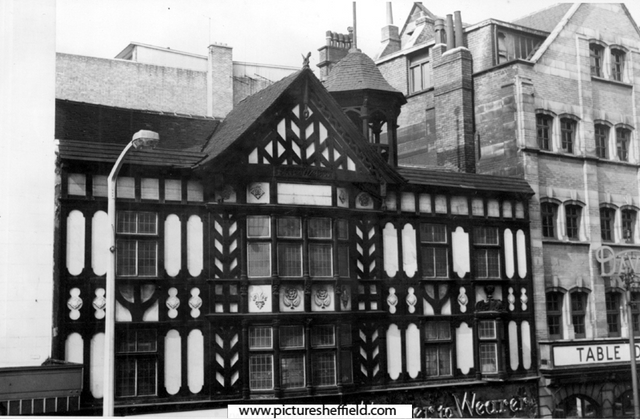
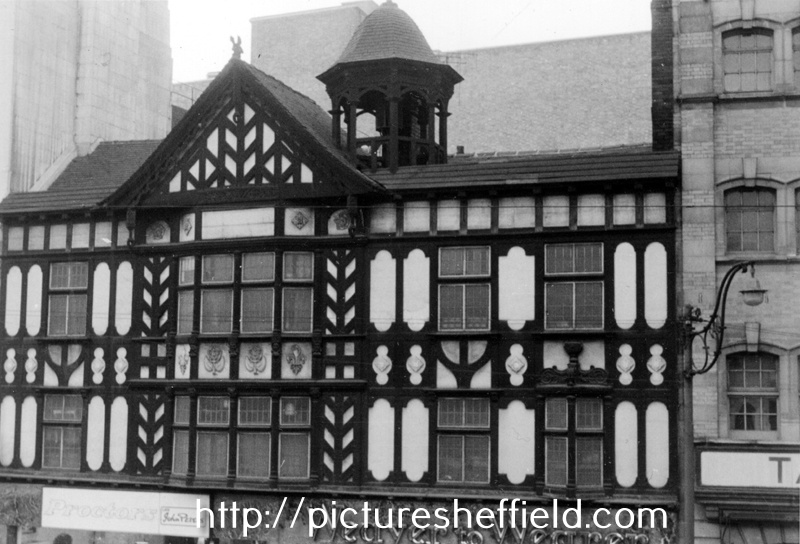
Tennant Brothers were probably responsible for the reimagining of Wiley’s building in the 1920s and the introduction of its Tudor-inspired appearance.
Here onwards, Wiley and Co was known as the off licence business for Tennant Brothers, with branches across Sheffield and the north, but the name would disappear after the Sheffield-based brewery was bought by Whitbread in 1961.
Wiley and Co and Old No.12 disappeared and the building was used by a succession of shops before Haymarket’s decline led to the arrival of amusement arcades.
© 2024 David Poole. All Rights Reserved
 sheffielder.net